
Last Updated: October 23, 2026
Quick Summary
An airport taxi is a pre-booked, door-to-door service with a scheduled pickup and a fare agreed before you leave, so Halifax residents should demand a confirmed booking, flight tracking, a licensed driver, and a fixed fare in writing. Verify licensing and insurance, confirm child seats and luggage capacity, and ask what surcharges sit outside the flat rate.
- Give the driver your flight number, not just your landing time, so delays adjust the pickup automatically.
- Ask whether the vehicle is registered and insured for commercial passenger service and get written confirmation.
- Confirm child seat type, weight range, and installation in writing when you book, not on arrival.
- A sedan suits two passengers with two checked bags; a family of five with four bags needs a minivan.
- Most operators include a grace period of 15 to 60 minutes after landing before billing waiting time.
Table of Contents
- What Halifax Residents Should Demand From an Airport Taxi
- Why Airport Taxi Booking in Advance Beats Hailing at the Curb
- How Airport Pickup Flight Tracking Protects a 2 AM Arrival
- How to Verify Licensing, Insurance, and Driver Credentials
- Airport Taxi With Child Seats: What Families Need to Confirm
- Airport Transfer Luggage Capacity and Vehicle Choice
- Fares, Flat Rates, and What the Extra Cost Actually Buys
- Backup Plans When a Booked Ride Fails
- Frequently Asked Questions
What Halifax Residents Should Demand From an Airport Taxi
An airport taxi is a pre-booked, door-to-door service that carries passengers to or from an airport terminal on a scheduled pickup, usually at a fixed fare.
The ride itself is rarely the problem, the gap between what you booked and what shows up is.
Below, we break down exactly what to demand, how to verify it, and what to do when something goes wrong.
Book the ride before you book the flight parking. A confirmed reservation with a fixed fare removes the two biggest variables from travel day: availability and price.
Why Airport Taxi Booking in Advance Beats Hailing at the Curb
Advance airport taxi booking wins on three counts: guaranteed availability, a locked fare, and a driver who knows your flight number. Hailing at the curb gives you none of those, just whatever is in the queue, at whatever the meter says.
For residents in Dartmouth or Bedford, the calculus is even clearer. A curb hail works when you are already standing at the terminal; it does not help you get there.
What to Have Ready When You Book
Booking takes minutes when you have the right details on hand. Gather these first:
- Full pickup address, including unit or building entrance
- Flight number and airline, both directions
- Number of passengers and checked bags
Give the driver your flight number, not just your landing time. Airlines move flights constantly, and a driver tracking the flight will adjust the pickup without you making a single call.
How Airport Pickup Flight Tracking Protects a 2 AM Arrival
Flight tracking means monitoring your flight’s live status and adjusting the pickup time automatically when it lands early, late, or gets delayed. It matters most on the trips nobody wants to think about: the red-eye landing at 2 AM, the connection that slips three hours, the diversion.
Without tracking, a delayed flight means a driver idling in a cell lot or, worse, a driver who left. With tracking, the pickup moves with you.
How to Verify Licensing, Insurance, and Driver Credentials
Verification is the step residents skip most often, and it is the one that protects you. Commercial passenger vehicles in Nova Scotia must be registered and insured for hire, and drivers must hold the correct class of licence.
- Is the vehicle registered and insured for commercial passenger service? A legitimate operator answers yes without hesitation.
- Is the driver licensed for hire and familiar with the airport terminal layout? Ask how drivers are vetted.
- Can I get a written confirmation with the fare and pickup details? A booking you can read is a booking you can hold someone to.
Nova Scotia Registry of Motor Vehicles on driver licensing publishes the licensing classes that apply to commercial drivers, so you can check what a valid credential looks like. A company that dodges these questions is telling you something.
A cash-only operator with no written confirmation and no company name on the vehicle is the single biggest red flag. If the ride fails, you have no booking record, no fare proof, and no one to call.
Airport Taxi With Child Seats: What Families Need to Confirm
An airport taxi with child seats must confirm three things in writing: the seat type, the child’s weight range, and that the seat is installed before pickup. “Child seats available” is not enough, families need the right seat for each child.
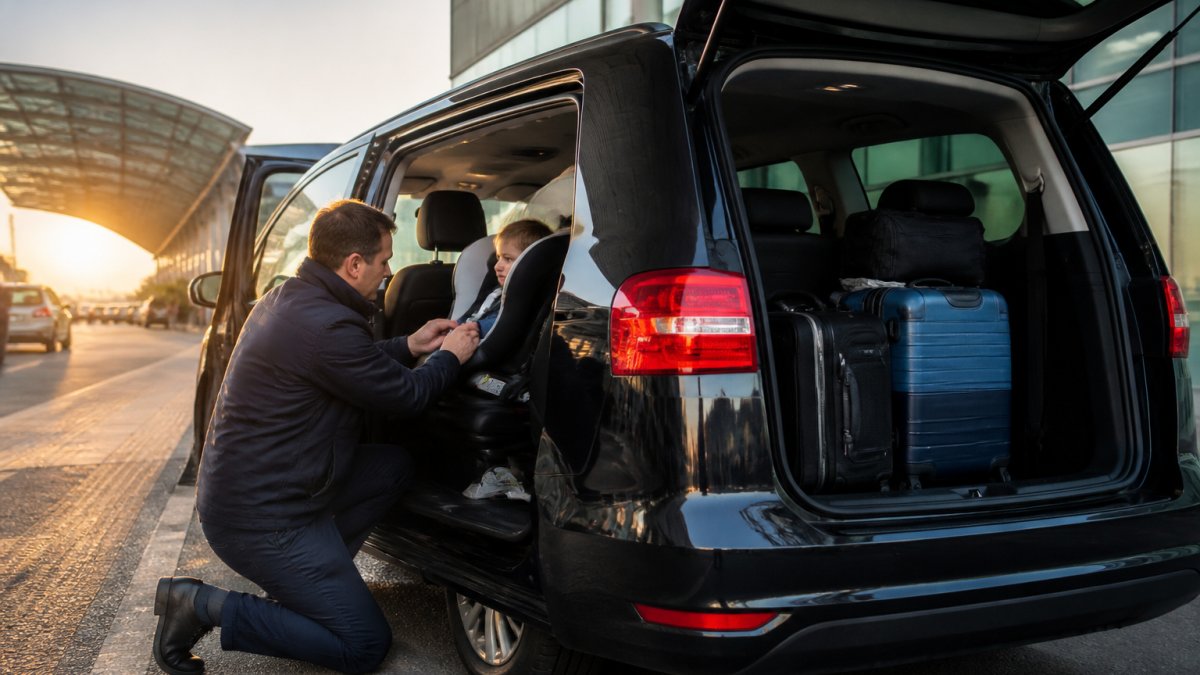
Confirm the seat category when you book, not when you arrive. Transport Canada sets the national standards for child restraint systems, and Transport Canada’s child car seat guidance explains the stages from rear-facing to booster.
Airport Transfer Luggage Capacity and Vehicle Choice
Luggage capacity decides the vehicle, and the vehicle decides the fare. A sedan handles two passengers with two checked bags; a family of five with four suitcases and two carry-ons needs a minivan or SUV. Booking the wrong size means a cramped ride or a second vehicle at your expense.
Matching the Vehicle to the Trip
Use this as a starting point when you book:
| Trip type | Passengers | Luggage | Vehicle to request |
|---|---|---|---|
| Solo business trip | 1 | Carry-on plus laptop bag | Sedan |
| Couple, week away | 2 | Two checked bags | Sedan or SUV |
| Family with young kids | 4-5 | Four bags plus stroller | Minivan with child seats |
| Group arriving together | 6-8 | Six or more bags | Minivan or large SUV |
| Corporate group or special occasion | 4-6 | Light luggage | Luxury car or limousine |
Deeplink Airport Taxi runs luxury cars, SUVs, minivans, and limousines, so a group of eight with two kids can travel in one vehicle.
Fares, Flat Rates, and What the Extra Cost Actually Buys
A flat rate is a fare agreed before the trip that does not change with traffic, route, or time of day.
So what does the premium over a curb taxi buy? Predictability, a confirmed vehicle at an hour when cabs are scarce, flight tracking, a driver who waits when your bags are slow, and a booking record if something goes wrong.
What Actually Drives Your Quote
Most operators build a flat airport fare from the same handful of inputs. Ask which apply to your trip:
- Distance and zone. A pickup inside the urban core is priced differently from a run out to Truro or the Annapolis Valley. Confirm whether your address is a standard zone or a custom quote.
- Vehicle class. Sedan, SUV, minivan, and limousine carry different rates. A sedan for a family of five with four bags costs more in the end because you need a second vehicle.
- Passenger and bag count. Extra passengers beyond standard seating, and oversized items such as skis, golf clubs, or surfboards, can trigger an additional charge. Declare them at booking.
Surcharges, Waiting Time, and Tolls
A flat rate is only flat if you know what sits outside it. Before you commit, get a straight answer on these:
- Waiting time. Most operators include a grace period after your flight lands, commonly 15 to 60 minutes, then bill waiting time in increments. Ask what the grace period and rate are.
- Early and late surcharges. Confirm whether an early-morning or overnight pickup adds a fixed amount or is already baked into the quote.
- Tolls and bridge costs. If your route crosses a tolled crossing, confirm whether the toll is included in the flat rate or added on top.
- Gratuity. Clarify whether the quoted fare includes a driver gratuity or is left to your discretion.
Payment Methods and Receipts
Ask how you can pay before you book: card in advance, card in the vehicle, or cash. If your trip is a business expense, confirm you will receive an itemized receipt showing the fare, any surcharges, and the date.
Pricing depends on distance, vehicle type, passenger count, time of day, and any extras you declare, so we quote each trip individually rather than publish a rate card that goes stale.
When you get your quote, read it for the words “inclusive” and “plus.” A fare that is inclusive of tolls, surcharges, and gratuity is the only number you can budget against. If anything is “plus,” ask for the amount in writing before you book.
Backup Plans When a Booked Ride Fails
Even a good booking can fail, so plan for it. The night before travel, save the operator’s phone number, confirm your pickup time by message, and note the terminal’s taxi stand as a fallback. If your driver has not arrived within ten minutes, call dispatch rather than waiting silently.
Match your backup plan to the specific way a ride tends to fail, because each failure mode needs a different response.
The Four Failure Modes and What to Do
1. The no-show at your door (outbound). Your driver has not arrived and the clock is running toward your flight.
2. The no-show at the terminal (inbound). You have landed, collected bags, and your driver is not at the meeting point.
**3.
4. Flight disruption on the inbound leg. A diversion, a cancelled connection, or a rebooked arrival time can strand a pickup.
Build the Backup Before You Need It
A few minutes the night before travel covers most scenarios:
- Save the dispatch number and confirmation number to your phone’s favorites, not just your inbox.
- Screenshot the booking confirmation so it is available offline.
- Identify one fallback ground-transport option for each end of the trip, a rideshare app and a local cab company.
- For early-morning departures, set a backup alarm and confirm the pickup by message the evening before.
Halifax Stanfield International Airport ground transportation information lists the ground transport options at the terminal, which is useful context if you ever need a plan B. A reliable operator will also give you a direct number and answer it.
Do not wait silently past your cutoff. The most common way a backup plan fails is that the traveler keeps hoping the driver will appear until there is no time left to execute the alternative. Set the cutoff in advance and act on it.
Screenshot your booking confirmation and save the dispatch number to your phone’s favorites before you travel. When you land tired and the Wi-Fi is slow, you will not want to dig through email.
Frequently Asked Questions
How can I check whether an airport taxi service is dependable?
Ask three things before you book. First, confirm the company is licensed and insured to carry passengers, and ask which vehicles and drivers are assigned to your trip. Second, get the fare structure in writing, including whether it is a fixed rate or metered and what extra fees apply. Third, read recent customer reviews for pattern problems like late pickups or no-shows rather than one-off complaints. A dependable airport taxi confirms your booking in writing, tracks your flight, and gives you a phone number a person actually answers.
How do airport taxis handle flight delays?
A properly run airport pickup flight tracking system monitors your flight number and adjusts the pickup time when the flight lands early or late, so the driver arrives when you do rather than at the originally scheduled hour. Confirm at booking that tracking is included and ask whether extended delays trigger any wait charge. This matters most on late-night arrivals, when a missed pickup leaves you with few options. Get the delay policy in writing so there is no dispute at the curb.
How much luggage can an airport taxi accommodate?
It depends on the vehicle class. A standard sedan typically handles two large suitcases plus carry-on bags for two passengers. SUVs and minivans carry more, and a minivan is usually the right choice for a family of four or more with checked luggage, strollers, or sports equipment. Tell the dispatcher the exact number of checked bags, carry-ons, and oversized items when you book so the right vehicle is sent. If your group is large, ask whether one vehicle covers everyone or whether you need two.
What should I do if my airport pickup is late?
Call the dispatch line immediately rather than waiting at the curb, and ask for the driver’s name, vehicle description, and current location. Keep your booking confirmation handy so you can quote the reference number. If the ride does not arrive within a reasonable window, ask the company to send another vehicle or release you from the booking. For early-morning departures, build a buffer into your pickup time and have a second option saved in your phone before travel day.
