
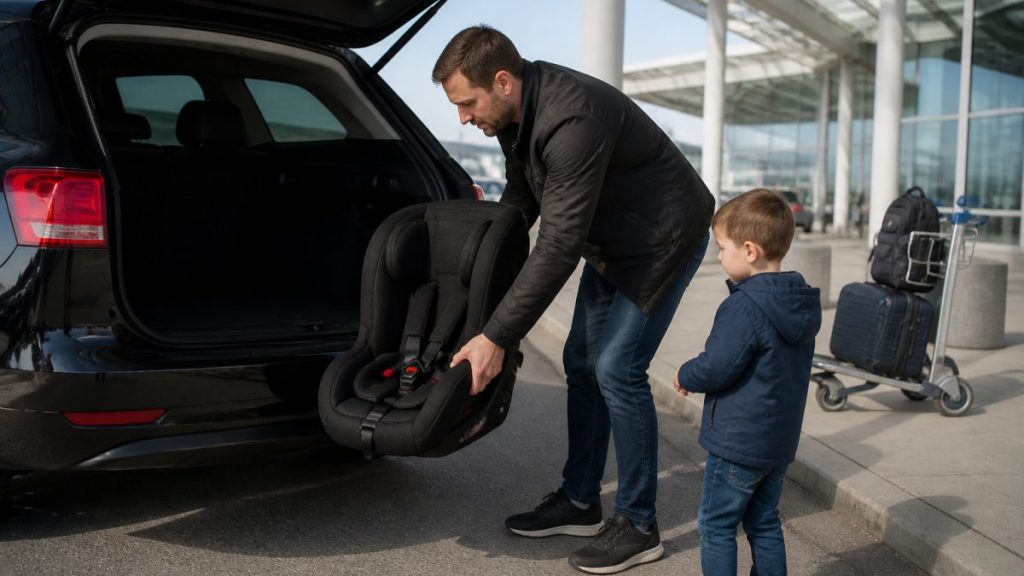
Table of Contents
- Why Families Book an Airport Shuttle with Child Seats in Halifax
- Child Seat Types, Sizes, and Age or Weight Suitability
- Nova Scotia Child Passenger Safety Requirements
- How to Arrange an Airport Transfer with Child Seat
- Booking an Airport Taxi with Car Seat: Shuttle, Taxi, or Private Transfer?
- Your Child Seat Booking Checklist
- Airport Pickup After Flight Delay: What Happens to Your Booking
- Conclusion
- Frequently Asked Questions
Last Updated: October 19, 2026
Why Families Book an Airport Shuttle with Child Seats in Halifax
Booking child seats Halifax airport shuttles provide solves a specific problem: you land at Halifax Stanfield with a tired child, two suitcases, and no safe way to buckle that child into a vehicle you didn’t bring. At Deeplink Airport Taxi, child seats are available upon request, so you’re not at the curb reasoning with a dispatcher at 11 PM.
What a Pre-Booked Seat Actually Solves
Standard taxis and rideshares aren’t required to carry child seats, and most don’t. Nova Scotia law requires children to be properly restrained, putting the responsibility on the adult traveling with them. That leaves three bad options: haul your own seat through the airport, hope a driver has one, or take a risk you shouldn’t take.
A reserved seat removes all three, and the negotiation. Tell us the child’s age and weight when you book. No surprises at the curb.
Book the seat at the same time you book the vehicle, not as a follow-up call. Seat inventory is limited on peak travel days, and a seat added later may not be available for your time slot.
Child Seat Types, Sizes, and Age or Weight Suitability
Three seat categories cover almost every child traveling through the airport, but the choice isn’t made by age alone. Weight and height together decide which seat is appropriate. The table below is a starting point, not a substitute for checking the seat’s label.
Rear-Facing, Forward-Facing, and Booster Seats at a Glance
| Seat Type | Typical Suitability | Facing Direction | What It Does |
|---|---|---|---|
| Rear-facing infant seat | Newborns to roughly 13 kg | Faces the rear window | Supports the head and spine in a crash |
| Forward-facing seat with harness | Roughly 10 to 22 kg | Faces forward | Five-point harness spreads crash forces |
| Booster seat | Roughly 18 kg and up | Faces forward, uses vehicle belt | Raises the child so the seat belt fits correctly |
Ages vary widely, so tell us the weight and height when you book. A tall four-year-old may have outgrown a rear-facing seat while a smaller five-year-old still fits one.
How to Pick the Right Seat Without Guessing
Start with the seat label, not the child’s birthday. Every seat sold in Canada carries a label stating the minimum and maximum weight and height, and that label is the authority on fit. If the child is near a boundary, give the provider both numbers and ask which seat they’d fit.
Height matters as much as weight. A forward-facing harnessed seat is outgrown when the shoulders rise above the top harness slot, even under the weight limit.
Edge Cases Families Actually Hit
- Two children of different sizes. A family with a toddler and a school-age child may need one harnessed seat and one booster. State both children’s weight and height separately; do not average them or assume one seat type covers both.
- A child just over a boundary. If a child is a kilogram over the rear-facing limit, the answer is a forward-facing harnessed seat, not a rear-facing seat with the straps loosened. Never stretch a seat past its label.
- A child who uses a medical or special-needs restraint. These are not standard inventory. Ask well ahead of travel whether the provider can accommodate the specific device, and be prepared to bring your own if the answer is no.
- A winter coat. A bulky coat compresses in a crash and leaves the harness loose. Fit the child without the coat, then put the coat on backward over the harness if warmth is needed.
Don’t book a booster for a child who still fits a harnessed seat. Boosters rely on the vehicle’s seat belt to hold a small body, and a child below the booster’s minimum weight can slide out of position in a sudden stop.
When you book, give the provider the child’s weight, height, and the seat type you believe is correct. If the provider suggests a different type, ask why.
Nova Scotia Child Passenger Safety Requirements
Provincial law requires children to be secured in an appropriate child restraint system while riding in a vehicle, and the rules apply to taxis and shuttles the same as they do to a family car. The Nova Scotia Registry of Motor Vehicles publishes the current requirements, and we recommend checking it before you travel, because weight thresholds and exemptions are updated from time to time.
What the Rules Require in Practice
The core requirement: a child must be in a restraint appropriate for their weight and height, used per the manufacturer’s instructions, the right seat, fitted correctly, harness snug, belt routed as the label shows.
The rules don’t require every taxi or shuttle to carry a child seat, they require that a child traveling in the vehicle be properly restrained. In practice, that puts the responsibility on the adult to confirm a suitable seat before the trip begins.
How the Rules Apply to Taxis and Shuttles
A common misconception is that taxis and shuttles are exempt from child restraint rules. They are not. A pre-booked seat, confirmed in writing, is the simplest way to stay compliant.
If you’re traveling with your own seat, check that the vehicle has the anchors or belt path it needs. Most modern seats use the vehicle’s seat belt, but a seat requiring lower anchors may not fit every taxi or shuttle. Ask before you book.
What to Do If a Suitable Seat Is Unavailable
Sometimes the answer is no. A provider may be out of the seat type you need on a peak travel day, or may not carry a special-needs restraint. In that case, the practical options are:
- Bring your own seat. Most airlines accept a child seat as checked baggage or, if you have booked a seat for the child, as an approved in-cabin restraint. Confirm the airline’s policy before you fly.
- Ask the provider to source one. Some providers can arrange a seat through a partner if you give enough notice. Ask how much lead time they need.
- Change the vehicle type. A larger vehicle may have more seat positions available, which can make a difference when inventory is tight.
- Re-time the trip. If your travel dates are flexible, a mid-week or off-peak arrival is more likely to have the seat you need.
The rule is not that every vehicle must carry a child seat. The rule is that every child must be properly restrained. Confirm the seat before you book, and you have met the requirement without a curb-side negotiation.
How to Arrange an Airport Transfer with Child Seat
Arranging an airport transfer with a child seat takes about five minutes with the right details ready: your flight number, your pickup or drop-off address, the number of passengers, and the age and weight of each child who needs a seat.
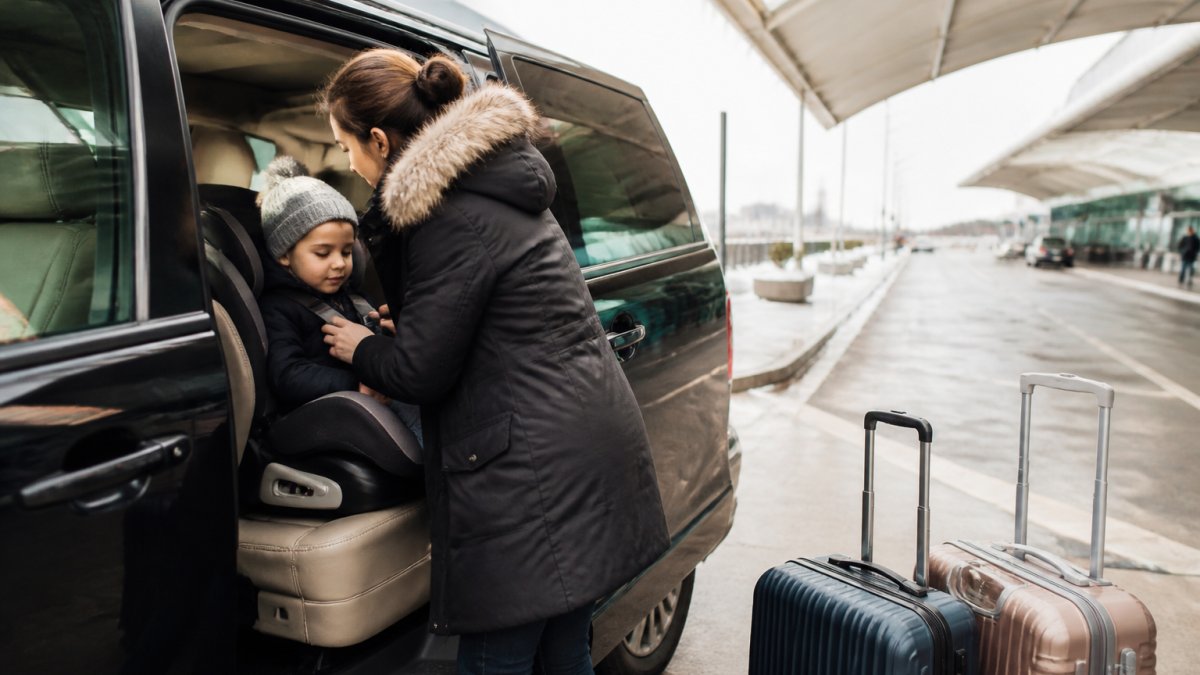
Here is the sequence we recommend:
- Book online or by phone as soon as your flights are confirmed. Online booking lets you note the child seat request in the same form.
- State the seat type you need, or give us the child’s age, weight, and height and let us match it.
- Confirm the request in writing. Ask for a booking confirmation that names the seat type, not just “child seat requested.”
- Reconfirm 24 to 48 hours before pickup. This catches any scheduling changes and gives us time to swap equipment if needed.
- Check the installation yourself before the vehicle pulls away. Tug the seat at the belt path. It should move less than a couple of centimetres.
For arrivals, give us your flight number so we track the landing time rather than the scheduled one. A Nav Canada advisory on arrival procedures isn’t necessary reading for passengers, but knowing your flight number is on file with us is what makes the pickup work.
Booking an Airport Taxi with Car Seat: Shuttle, Taxi, or Private Transfer?
Choosing between a shared shuttle, a taxi, and a private transfer comes down to how many people are traveling and how much certainty you need. An airport taxi with car seat service booked in advance behaves like a private transfer: the vehicle is yours, and the price is agreed before you travel.
Shared shuttles cost less per person but often can’t guarantee a specific seat type, and you may wait for other passengers. A taxi hailed at the rank is the least predictable option, since seat availability depends entirely on the driver.
The deciding question isn’t price. It’s whether you can confirm, before you land, that the correct seat will be in the vehicle.
Your Child Seat Booking Checklist
Use this checklist before you confirm any booking. It covers the details that get missed when you book in a hurry.
- Flight number and airline recorded on the booking
- Child’s age, weight, and height given to the provider
- Seat type named explicitly in the confirmation
- Number of passengers matches the vehicle capacity
- Luggage count stated, including strollers and travel cribs
- Pickup address includes building entrance or terminal details
- Contact number for the driver or dispatch saved to your phone
- Booking reconfirmed 24 to 48 hours ahead
- Payment method and any deposit terms understood
- Cancellation policy reviewed
Confirming the Seat Is Reserved and Installed
A confirmation that says “child seat requested” isn’t enough. Ask for the seat type by name, and whether it will be installed before the driver leaves the depot or fitted at the curb. Installed in advance is better, it removes a step in the cold at the terminal.
Airport Pickup After Flight Delay: What Happens to Your Booking
A flight delay doesn’t cancel your pickup when you book with a provider that tracks your flight number.
What matters is the price. Ask before you book whether the rate is flat or metered by waiting time.
For early departures, the same principle applies in reverse. A 5 AM pickup needs a confirmed booking, not a hope that a driver is awake.
What if the delay is severe enough that you land after your booked window? Call dispatch as soon as you know. Providers that run 24/7 can usually re-slot the pickup.
Conclusion
Traveling with children through Halifax Stanfield doesn’t have to involve a curb-side scramble over car seats. The work happens before you fly: state the child’s age and weight, get the seat type named in your confirmation, and reconfirm a day or two out.
At Deeplink Airport Taxi, we provide 24/7 airport transfers with child seats available on request, across a fleet that includes minivans and SUVs for larger families. Every vehicle comes with extra legroom and adjustable climate controls, and our drivers are experienced with family travel.
Frequently Asked Questions
Can I request a child seat when booking an airport transfer?
Yes. Child seats are available on request, but they are not automatic, so state the request when you book rather than at the curb. Give the child’s age, weight, and height, and confirm the seat in writing on your reservation.
Should I bring my own child seat for an airport transfer?
Bringing your own seat guarantees a familiar fit, but it adds luggage and you have to install it at the curb. If your child is used to a specific seat, or you need it at your destination, bring it. Otherwise, requesting a child seat from your provider is an option for a short transfer to or from the airport.
How should I plan an airport pickup if my flight is delayed?
Book with a provider that tracks flight numbers so the pickup time moves with your actual arrival, and ask whether waiting time is included in the flat rate. Share your flight number at booking, keep your phone on after landing, and message the provider if you are held up in baggage claim.
Where can I pick up passengers at the airport?
Curbside pickup rules and designated meeting points at the terminal are set by the airport, and they change with construction and traffic flow. Ask your provider where the driver will meet you, whether that is a numbered post, a rideshare zone, or a cell phone lot, and get the driver’s contact details before you land. For families with children and luggage, a pre-arranged meeting point saves a long walk with a stroller and bags.